Gracious Legend

January 18, 2012 – It’s difficult to imagine having as much fun at work as I did on Saturday Jan. 7.

On that balmy, 50-degree day, I had the opportunity to give Hall of Fame quarterback Dan Marino a VIP tour of Yankee Stadium before interviewing him in my office for a feature story on his trip to the ballpark, which will be published in the April 2012 issue of Yankees Magazine.

The day was especially meaningful for me, not only because I was in the presence of a guy who set NFL records for touchdown passes, passing yards and completions during his 17-year career with the Miami Dolphins, but also because Marino was my favorite athlete as child.

When I was 7 years old, my father and my grandfather took me to the Orange Bowl stadium in Miami to see Marino and the Dolphins take on the Atlanta Falcons. That experience left an indelible mark on me, and it was the foundation for my interest in sports.

The recent afternoon at Yankee Stadium was even more special because my wife, Tiana and my son, Alfred, joined me on the tour. To have the chance to spend time my childhood hero, and to share the experience with my family was as meaningful as anything I’ve done with the Yankees — save for the 2009 World Series. But what turned the afternoon into one of the great memories of my life was Marino’s kind demeanor.

As a kid, I rooted for the Yankees and for the Miami Dolphins. Dan Marino was my favorite athlete because of his ability to throw a football, his competitive fire and because from a far (I grew up in New Jersey), he seemed like a good guy.

While I had met Marino briefly in 2002 — when I worked in the media relations department of the Miami Dolphins — I really didn’t get to know him. But on this afternoon at Yankee Stadium, I quickly came to the realization that Marino is an even greater person than he was a football player.

Marino was gracious in every way. When we were driving to the Stadium from Manhattan, I told Marino that my young son would be joining us on the tour, and his response was, “that’s awesome.”

From the minute we walked through the lobby, Marino took time to talk with everyone in our group, including Alfred and Tiana. Marino thanked everyone who he met that afternoon from the security personnel in the lobby to New York Yankees Museum curator Brian Richards and Yankees team photographer James Petrozzello.

Our tour began on the football field — the 2011 New Era Pinstripe Bowl was played at Yankee Stadium a week prior and the field had not yet been converted back to a baseball diamond. Once we got to the 50-yard line, Petrozzello asked Marino to pose for a few photos while the quarterback was holding a football.

Before Petrozzello could take a shot, Marino was already throwing the football to anyone who was willing to catch it.

I quickly put my hands up and asked myself if I was really catching passes from Dan Marino at Yankee Stadium!

After Petrozzello captured the image below, Marino continued to toss passes to the people in our group. After about the fifth pass Marino threw to me, I complimented him by saying, “You’ve still got it. You can still fire that ball pretty hard.”

Marino responded with a laugh, and then told me that he was taking it easy on me. I then asked him to “throw me a real Dan Marino pass.”

That’s when I experienced what I had always heard about. Maybe it was an illusion, but it appeared as if the ball actually gained speed as it got closer to me. I had a few near misses, but fortunately, I was able to catch all of Marino’s bullet passes.

I had purchased a small football for my son when I picked up the pigskin for the photo shoot, and as soon as Marino saw the small football, he grabbed it and began playing catch with the pint-sized receiver.

As amazing as it was to catch a few passes from one of the single greatest quarterbacks in history, the experience of watching Marino throw passes to my boy was even more surreal and greater.

From the field, we walked to Monument Park, where Marino took in some of the Yankees storied history.

Following that stop, Marino was treated to an exclusive tour of the New York Yankees Museum, where Richards (museum curator) had taken out the bat that Babe Ruth used to swat the first home run at the old Yankee Stadium, along with Ruth and Gehrig’s jerseys and the hat that Mickey Mantle wore in 1961.

Marino held each of those treasures and posed for photos with them. Before we left the museum, Richards handed Marino the 2009 World Series trophy.

I interviewed Marino in my office after the tour of the Stadium. In our conversation, the Pittsburgh native, who was the Kansas City Royals’ fourth-round draft pick in 1979, discussed his affinity for baseball.

“I loved playing baseball when I was younger, and I was proud that the Kansas City Royals drafted me,” Marino said. “I started playing baseball when I was 7 years old. I was a shortstop, and I also pitched. I won 25 games my senior year, and I didn’t lose a single game. I could have played in the Royals system, but in order to play baseball professionally, I would have been required to forfeit my football scholarship at the University of Pittsburgh and to foot the bill for tuition. The Royals offered me a $30,000 signing bonus, but that would not have covered my scholarship, so I didn’t try to play both sports. I think I made the right decision in concentrating on football!”

Of course, Marino and I discussed the quarterback’s legendary football career, including the 1984 season, when he broke single season records for completions, passing yards and touchdown passes.

“We were just trying to win football games, but we broke a lot of records along the way,” Marino said. “Going into the last game of the year, Mark Clayton needed three touchdowns to break the single-season touchdown record, and I needed a certain amount of yards to break Dan Fouts’ record for passing yards in a single season. We also needed to win the game, so I wasn’t even thinking about the records. All of a sudden, I realized that I was the first person to throw for more than 5,000 yards. That record lasted for 27 years, and it’s great to think we did something that no one had ever done.”

I also asked Marino a few Yankees-related questions, including one about Alex Rodriguez, who grew up in Miami, and who admired the Dolphins quarterback so much that the third baseman chose number 13 when he was traded to the Yankees.

“It makes me very proud [that he wears number 13],” Marino said. “When I was playing for the Dolphins, I hosted a television show at my restaurant every week. Alex came to the show for the first time when he was 16 years old, and he introduced himself to me that night. I followed him in high school, and after he was drafted, he came to a few of our practices. Today, we’re members of the same golf club, and he’s a good friend. Alex’ stats speak for themselves. He’s been an incredible player for a long time.”

Finally, for this blog, I asked Marino to grade me as a receiver.

“At least you didn’t drop one!” Marino said through a laugh. “But when I saw your technique, I decided to take it easy on you because I didn’t want you to get hurt.”

–Alfred Santasiere III

Derek Jeter’s Field

January 5, 2012 – At this time, we are planning for the cover story of the April 2012 issue of Yankees Magazine to be on Derek Jeter.

On December 15 — a few hours after having lunch with Lou Carnesecca — I traveled to Kalamazoo, Michigan to spend some time with Jeter in his hometown and to cover a ceremony at Jeter’s High School in which the baseball field was named after him.

The ceremony took place in the Kalamazoo Central High School auditorium on Friday December 16. Prior to the unveiling of a large sign that reads, “Welcome to Derek Jeter Field, Home of the Kalamazoo Central High School Maroon Giants,” Jeter, along with two of his coaches and the current principal, spoke about the honor.

A few hours before the ceremony, Yankees team photographer James Petrozzello and I met up with Jeter on the field (which was soon to be named after him).

It was the perfect setting for me to interview the Yankees captain about the fact that his name would permanently be attached the field he learned the game on.

Despite some snow flurries, a lot of cold wind and temperatures in the low 20s, Jeter took the time to reminisce about his childhood and the times that he spent on the high school field.

“The house I grew up in is on the other side of that fence,” Jeter said as he pointed to a blue house in the distance. “I used to jump the fence to come to school and to get to this field. I was over here all the time. In fact, I probably spent more time on this field playing baseball with my family than I did with my team.”

I believe this story will be a special read for many reasons, including that fact that not only did Jeter play on this field in high school, but for all intent and purposes, it is where he learned to play the game.

The photos that Petrozzello took of Jeter on the field — which is surrounded by pine trees in a rural setting — are incredible. You will only find these beautifully-lit portraits in this exclusive story, because we were the only people who were given such exclusive access to Jeter on this special day.

I also had the opportunity to capture the words of both of Jeter’s coaches, along with two of his high school teachers. Each of these mentors had their own memories of Jeter before the rest of the world knew him, and each of those recollections will be part of the story.

On a personal note, I am proud of the fact that I have now interviewed Jeter on the field in which he first played competitive baseball, and I also interviewed Alex Rodriguez (for a 2011 feature story in Miami, Florida) on the field where he first played the game.

I’ll leave the rest of the Jeter story to your imagination until Opening Day, but I will share one more quote. As we were walking off the field, Jeter turned to me and said, “I always referred to this as my field. Now, it really is my field.”

–Alfred Santasiere III

An Unforgettable Afternoon with Lou Carnesecca

January 5, 2012 – Since we established, the “5 Minutes with…” feature in Yankees Magazine, we’ve been fortunate enough to bring the words of some of the greatest names in sports and entertainment — along with several dignitaries — to our fan base.

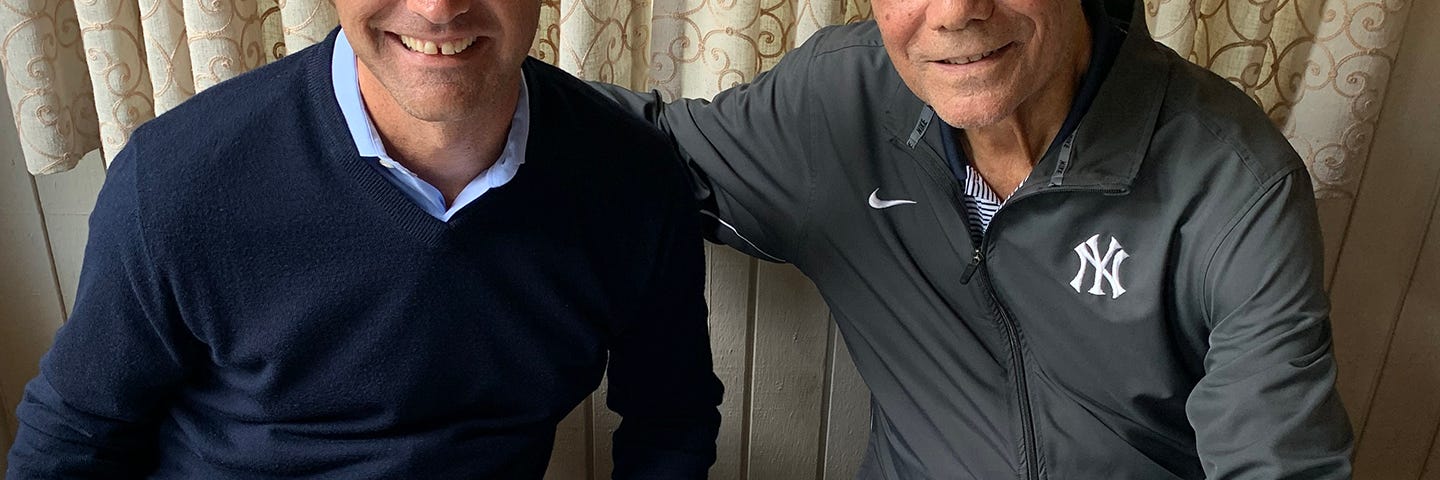
Of all of the “5 Minutes with…” interviews I’ve conducted since 2007, the one that I enjoyed the most took place on December 15. Before Yankees team photographer James Petrozzello and I flew to Michigan for the Derek Jeter story (see blog entry above), we had lunch with longtime St. John’s University basketball coach Lou Carnesecca at Acquista Trattoria — an Italian restaurant a few blocks from the school’s Queens campus.

Carnesecca, who was inducted into the National Basketball Hall of Fame in 1992, is one of the most down-to-earth, kindest and most interesting people I have ever met.

When we sat down for lunch, I thanked the 87-year-old Italian immigrant for taking the time to meet us, and he responded by saying, “It’s an honor.”

In reality, I was the one who was honored to be in the presence of one of the most accomplished coaches in American history, a man who won 526 games at St. John’s in 24 seasons, and who is recognized for always doing things the right way.

Our lunch lasted almost two hours, as the coach shared story after story with our group, which included my father, a graduate of St. John’s School of Law.

Carnesecca’s sense of humor and wit captivated the room, especially when discussed the origin of his famous sweaters.

“You had to bring that up!” the coach said when I asked him where the tradition began. “We were getting ready to travel to Pittsburgh, and I had the flu. My wife told me to pack a sweater, so I grabbed two sweaters that were given to me by the coach of the Italian National team in the early 1980s. I thought they were ugly, and I had never taken them out of the closet, but I took them with me anyway. The arena we were playing in out there was cold, and I decided to wear one of the sweaters. When I came out of the locker room, everyone was laughing at me. But Chris Mullen hit a jump shot at the buzzer to win the game, and from then on, I had to wear a sweater on game days. I have received almost 200 sweaters from all over the world since then. People send me notes with the sweaters, saying things like, “This sweater is good for 10 wins.”

Carnesecca also discussed a piece of advice that was literally given to him by his predecessor, Joe Lapchick, many years ago. The advice, which is written on a piece of paper that Carnesecca still keeps in his wallet today, reads, “PEACOCK TODAY, feather duster tomorrow.”

“Coach Lapchick was in basketball for 50 years, and he taught me to always treat my players with respect,” Carnesecca said. “One night, after I had just received an award in New York City, he gave me this piece of paper. I didn’t read it that night, but it has always reminded me never to get a big head and to never get over confident.”

Following lunch, we walked to the St. John’s campus, where Petrozzello took two portraits of Carnesecca. The first location he photographed Carnesecca in was the coach’s present-day office, which looks more like a museum than an office.

The walls of the office are covered from floor to ceiling with mementos — including photos of Carnesecca with everyone from Pope John Paul II to many former St. John’s players.

Our last stop was at the arena, in which St. John’s plays most of its home games.

When we arrived at Carnesecca Arena, Petrozzello snapped a portrait of Carnesecca, which you will see in the April issue of Yankees Magazine.

–Alfred Santasiere III

Five Minutes with… Shaq

January 5, 2012 – Opening Day may still be a few months away, but we are already working diligently on the first few issues of Yankees Magazine for 2012, which includes the April edition.

That issue will feature two “Five Minutes with…” interviews with two basketball legends.

The first of those pieces features Shaquille O’Neal, who I sat down with on November 16 at the YES Network studios.

In the interview, Shaq talked to me about his new book, Shaq Uncut, along with his early days in Newark, New Jersey, and the differences between his on-court and off-court personalities.

“My on-court personality is an act.” the 7-foot-1 inch retired star said. “The NBA stands for “Nothing But Actors.” I try to do the same thing that Dr. J did for my father and I. It was hard for my father to afford to take me to a game, but when he scrounged together $40 and took me to a game, it was the best time of my life. When I saw all of the fathers who were struggling to pay their mortgages, but who wanted to make their kids happy by taking them to a basketball game, I wanted to give them a show that they would never forget.”

For me, the highlight of the interview came when Shaq interrupted himself to inquire about my 2009 World Series ring.

“Nice ring,” he said mid-sentence. “Can I wear it?”

Of course, I took the ring off of my finger and placed it in his giant hands. As you will see in the photograph below, Shaq could only fit the ring halfway down his pinky finger.

As he handed the ring back to me, he reiterated how special he thought it was, to which I said, “You have four championship rings.”

The future Hall of Famer responded.

“Yeah, but none of my rings have the Yankees logo on them.”

–Alfred Santasiere III

Back to the Beginning

January 5, 2012 – On the day before Thanksgiving, I made a visit to my old stomping grounds.

From 1999 through 2001, while I was an undergrad at Misericordia University in Dallas, Pennsylvania, I worked in the media relations department of the Wilkes-Barre/Scranton Penguins of the American Hockey League. The Pittsburgh Penguins affiliate was the perfect place for me to begin my career in sports, mostly because of the people that I had the opportunity to work with at that time.

One of those people is Tom Grace, who is now the team’s senior director of broadcasting and who has been the voice of the Penguins for many years.

Tom has always led by example, and I learned a lot from watching him go about his business. He treats everyone who crosses his path with respect, and he goes out of his way to assist colleagues. Tom is also as talented of a play-by-play announcer as there is in the game of hockey.

Tom’s presence, along with the fact that the Penguins led the AHL in attendance in the 1999-2000 and 2000-2001 seasons, hosted the AHL All-Star Game in 2001 and fielded a team that advanced to the AHL Finals later that year, made for a National Hockey League type atmosphere in Wilkes-Barre, PA.

In between the second of third periods of the game I was at in November, I joined Tom on air to discuss my career, and the evolution of Yankees Magazine over the last five years.

It was a memorable experience, and I will forever be grateful to Tom for his guidance and friendship and for the kindest of compliments.

“You’re legend continues to grow in Wilkes-Barre and in this arena,” Tom said as the intermission came to an end.

–Alfred Santasiere III

This One’s for Big E

December 30, 2011 – Last year’s Pinstripe Bowl ended in dramatic fashion with Syracuse holding on to a two-point win despite a mad-dash comeback by Kansas State in the final minutes of the contest.

Well, I guess this bowl is meant to have exciting finishes because the fourth quarter of the 2011 game was almost as thrilling.

At the start of the fourth quarter, Rutgers held a 20-6 lead. Iowa State capped a long drive when running back Jeff Woody dashed 20 yards for a touchdown with 10 minutes to play. Woody’s run brought Iowa State to within a touchdown of Rutgers at 20-13.

Rutgers quarterback Chas Dodd connected with Brandon Coleman on an 86-yard pass that expanded Rutgers’ lead to 27-13, before Iowa State put together a drive that led them Rutgers’ 10-yard line. Iowa State couldn’t convert on a fourth down pass attempt with five minutes left to play, and they would not score again.

The noise level seemed to be twice as loud in the second half, as Rutgers took the well-earned New Era Pinstripe Bowl trophy from the Bronx to it’s new home in Piscataway, New Jersey.

A few seconds after Rutgers head coach Greg Schiano hoisted the Pinstripe Bowl trophy above his head, he delivered what may have been the quickest celebration speech in college football history.

“Big E,” Schiano shouted as he pointed to the suite where Eric LeGrand (who was paralyzed from the neck down in a 2010 game) watched the game from. “This one’s for you.”

–Alfred Santasiere III

Exciting Atmosphere at the 2011 New Era Pinstripe Bowl

December 30, 2011 – At the start of the second half, Rutgers University is leading Iowa State University by a score of 17-6 in the 2011 New Era Pinstripe Bowl.

Rutgers came into the game with an 8-4 record including a victory against Army at Yankee Stadium in November. Iowa State entered the contest with a 6-6 record. Iowa State’s last win of the regular season came against Oklahoma State University, which posted an 11-1 record, and which will be playing in the Fiesta Bowl next week. That Oklahoma State team scored 59 or more points in five games this season, and were defeated in double overtime by the Cyclones of Iowa State.

Rutgers, which is located about an hour from Yankee Stadium, didn’t play as difficult of a schedule as Iowa State, but they did defeat Syracuse, Pittsburgh, Navy and Cincinnati earlier this season.

Needless to say, the play on the field is competitive. Meanwhile, the atmosphere in the stands is electric.

Rutgers’ fan base is well represented today. From my vantage point in the press box behind the end zone, the left-field bleachers are packed tightly with Rutgers followers (donning scarlet red) and about three quarters of the seats in the first two levels of the Stadium are also packed with Scarlet Knight fans.

The remaining seats in the first two decks of the Stadium, along with nearly all of the space in the right-field bleachers, are filled with Iowa State loyalists.

All in all, the Stadium atmosphere favors Rutgers, but it’s hard not to be impressed with the way Iowa State traveled to New York for this game.

Eric LeGrand, the Rutgers player who suffered spinal cord damage and two fractured vertebrae in a 2010 game and who is paralyzed from the neck down, was interviewed on the centerfield video board at the start of the third quarter.

In a touching moment, the entire crowd of 38,328 applauded each time LeGrand answered a question. I would be hard pressed to write much of what LeGrand said, because it was one of the loudest moments of the game — and that’s saying something considering that it’s been an energetic atmosphere since the kickoff.

–Alfred Santasiere III

Sacred Ground

December 30, 2011 — A few nights ago, I had to the opportunity to cover a visit that both teams made to the National September 11 Memorial.

It was my first trip to the sacred grounds, and I will never forget the moment I first saw the two reflecting pools, which are in the exact places that the twin towers stood.

When I first saw the size of each reflecting pool (they are each more than one square acre), it gave me greater perspective of the enormity of the tragedy.

But the site of the beautiful waterfalls, which flow into large pools, also gave me a sense of pride for everyone who lost their life on Sept. 11, 2001. The reflecting pools are not overstated, but are instead a perfect tribute to thousands of mothers, fathers, sons and daughters who didn’t come home on that our country’s worst day.

I read as many names — which are engraved on the exterior of each pool — as I possibly could during the time in between each team’s visit to the site. And when the wind came though the area, I got splashed by the water in each pool.

It was a cold night, and the water on my face didn’t make it any warmer, but in a way, the mist added the peacefulness of what is now a placid place to remember so many people.

Following Iowa State’s visit, I spoke to Cyclone running back Jeff Woody, who is from Iowa, and who was 10 years on in 2001.

From the minute our conversation began, it was obvious that Woody had a special sense of compassion for the victims of a tragedy that took place at a time when he was too young to fully grasp it.

“To look at a structures in New York City that appear to be as stable as can be, and to think that there were 3,000 people who can’t go home to see their families is a reminder of the greatness and the depths of humanity all in one,” Woody said. “At times like this, I really don’t think about football. This is a grave site for 3,000 people, and I can’t even put that into words to give you an idea of what I am feeling right now.”

“We got our schedule for this week after our game against Kansas State,” Woody continued. “This was the thing I was looking forward to the most, not because of excitement but because of respect. I circled this night on the calendar.”

–Alfred Santasiere III

American Heroes

November 12, 2011 – I spent the third quarter of today’s game between Army and Rutgers with a group of young men and women who were severely injured while serving in the United States Military.

The brave soldiers, who I was honored to meet and spend a few minutes with, were at the game with the Wounded Warrior Project, an organization that raises awareness and enlists the public’s aid for the needs of injured service members and helps injured soldiers by providing them with unique programs and services.

Today, more than 30 of those American heroes watched the game from the Mohegan Sun Bar at Yankee Stadium, courtesy of Navistar Defense, a company that produces military vehicles.

For me, the time I spent with the Warriors was the best part of the game, because I got to converse with people who have made incredible sacrifices so that millions of Americans can have experiences like the one I had today — watching a football game at Yankee Stadium.

The Army football team played an inspired game, keeping the contest within a touchdown until the last few minutes of the fourth quarter against a talented Rutgers team that is now 7-3 and will be playing for first place in the Big East next weekend.

As inspiring as Army’s effort was in a hard-fought lose, it didn’t compare to the energy that the Warriors exuded in watching the game.

–Alfred Santasiere III

Little-Known Tradition

November 12, 2011 — In addition to covering today’s Army vs. Rutgers game for a story in the 2012 New York Yankees Official Yearbook, I had the opportunity to write a feature story for Army’s Game Day Program.

The story that I scribed for today’s program details not only Army’s history of playing football games at Yankee Stadium, but also the New York Yankees history of playing baseball games at West Point.

As I researched the 21 games that the Yankees played against Army at West Point from 1927 through 1976, I began to realize how many great moments took place in that series.

Babe Ruth played in exhibition games at West Point, and in his last at-bat at Doubleday Field, he hit one of the longest home runs the in the history of the cozy ballpark. Joe DiMaggio played there, as did Mickey Mantle and Yogi Berra.

As former Yankees first baseman Joe Pepitone told me, he and Mantle missed the Yankees bus to West Point before the 1964 game, took a limousine and arrived as the game was beginning. The two stars, who Pepitone said were out very late the night before, were greeted by a chorus of cheers from the cadets as they arrived on the field.

“Fortunately, we had our uniforms with us, and we literally changed into them on the way up there,” Pepitone said. “Mickey told the driver to pull onto the field. All of the cadets were applauding as we got out of the limo in our uniforms, but the manager wasn’t too happy with us.”

I also spoke to Barry DeBolt, who nearly pitched Army to what would have been the Cadets only victory against the Yankees. In 1966, DeBolt gave up a first inning run on a ground ball to Mantle, which scored a runner from third base. The former cadet held the Yankees without a run the rest of the way, but took a 1-0 loss.

“I have the scorecard from that game in a shadow box,” said DeBolt, 67, who went on earn an MBA from the University of Pennsylvania’s Wharton School of Business and ran the investment department of a financial planning firm for 25 years. “After the first inning, I didn’t get into any trouble the rest of the game.

“I had never pitched against a major league team, so I was extremely excited,” DeBolt continued. “Once the game got going, it didn’t feel different from any other day, but in the beginning, I had some trepidation about pitching against a team of that magnitude, particularly with guys like Mickey Mantle and Roger Maris in the lineup.”

As if that day wasn’t interesting enough, former Army basketball coach Bobby Knight added to the lore. While the game was going on, the now NCAA all-time wins leader played hoops with several Yankees — who were lifted in the middle innings — in a gym that was within walking distance to the baseball field.

The Yankees haven’t played a game at West Point since 1976, and whether you followed the Yankees when they played there or not, this story will open your eyes to a little-known tradition that had it all.

This story will also be published in an issue of Yankees Magazine in 2012. I will be sure to note which issue it will appear in on this blog.

–Alfred Santasiere III

Follow

Get every new post delivered to your Inbox.